Be Like the Fox: Machiavelli In His World by Erica Benner
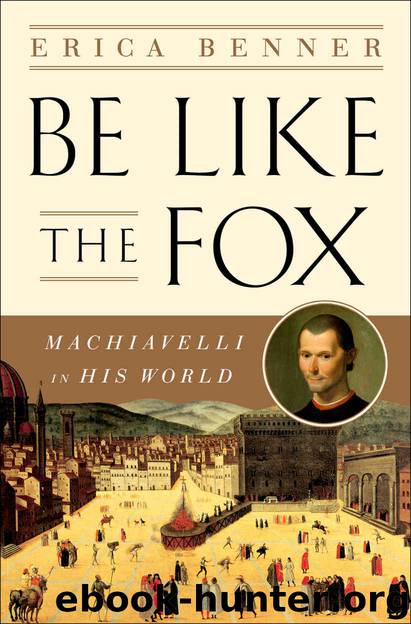
Author:Erica Benner [Benner, Erica]
Language: eng
Format: azw3
Publisher: W. W. Norton & Company
Published: 2017-05-09T04:00:00+00:00
12
How to Win
Towards the end of 1504, in his poem Decennale, Niccolò stands back and surveys Italy’s hectic political biography over the past decade. He is thirty-five, a father of young children and a functionary who helps implement life-and-death decisions about foreign and defence policy, but whose hereditary insolvency bars him from sitting on the magistracies that make those decisions. Yet he cannot help scrutinizing the decisions others make and noticing how often they fail to get to the root of problems, so that they soon wind up repeating them.
He writes his poem in the form of a direct address to his fellow citizens, speaking throughout of what ‘you’ Florentines did or failed to do to make yourselves safer since 1494. By 1504, Vitellozzo, Pope Alexander, and Piero de’ Medici – who early that January had drowned in battle – were all dead. Cesare Borgia was as good as dead. One by one, Florence’s mortal enemies had fallen. But the Decennale asks the Florentines to study their city’s recent history in an honest, self-critical spirit. Examine yourselves, it says, before you start thinking that the fortunate downfalls of a few old nemeses make you any safer. People who say so are like those who, when the sun shines for a day, don’t believe that it will ever rain.1
And while we Italians tear each other to bits, mightier foreign powers bring their armies here to fight over Italia’s poor lacerated carcass. Ten years on:
By no means is Fortune yet satisfied,
she has not put an end to Italian wars,
nor is the cause of so many ills wiped out.
And the kingdoms and the powers are not united . . .2
But fortune will never put an end to those wars because bad fortune is not their cause. Though the element of randomness in human affairs that people call fortune can be powerful, contemporary Italians overrate its powers and underrate their own capacities to shape events. The Decennale ’s political message is that Florentines and other Italians are responsible for their own defences. Their recent failures can’t be put down to the bad luck of being exposed to foreign predators, but only to their own bad choices. If they ever face up to this uncomfortable truth, they might have some chance of standing up for themselves.
By the time Niccolò starts to write his poem, he is hard at work on a remedy – and he plans to use the Decennale to help promote it among Florentine citizens. Until Italians have their own armies, nothing much would change. Events in the decade since 1494 have convinced him of that, and he wants others to wake up and realize it with him. Until recently a mere pipe dream, his fantasy of forming a Florentine citizen militia now has the support of some of the city’s most powerful men. He had often talked of it to Cardinal Francesco Soderini. Inspired by his younger friend’s confidence in his project and impressed with his attention to detail, the cardinal had taken Niccolò’s idea to his brother Piero.
Download
This site does not store any files on its server. We only index and link to content provided by other sites. Please contact the content providers to delete copyright contents if any and email us, we'll remove relevant links or contents immediately.
| Africa | Americas |
| Arctic & Antarctica | Asia |
| Australia & Oceania | Europe |
| Middle East | Russia |
| United States | World |
| Ancient Civilizations | Military |
| Historical Study & Educational Resources |
Room 212 by Kate Stewart(5120)
The Crown by Robert Lacey(4815)
Endurance: Shackleton's Incredible Voyage by Alfred Lansing(4782)
The Iron Duke by The Iron Duke(4354)
The Rape of Nanking by Iris Chang(4213)
Joan of Arc by Mary Gordon(4110)
Killing England by Bill O'Reilly(4001)
Say Nothing by Patrick Radden Keefe(3985)
I'll Give You the Sun by Jandy Nelson(3447)
Shadow of Night by Deborah Harkness(3368)
Hitler's Monsters by Eric Kurlander(3342)
Mary, Queen of Scots, and the Murder of Lord Darnley by Alison Weir(3210)
Blood and Sand by Alex Von Tunzelmann(3203)
Eleanor & Park by Rainbow Rowell(3173)
Darkest Hour by Anthony McCarten(3133)
Margaret Thatcher: The Autobiography by Thatcher Margaret(3082)
Book of Life by Deborah Harkness(2939)
Red Famine: Stalin's War on Ukraine by Anne Applebaum(2934)
The One Memory of Flora Banks by Emily Barr(2863)
